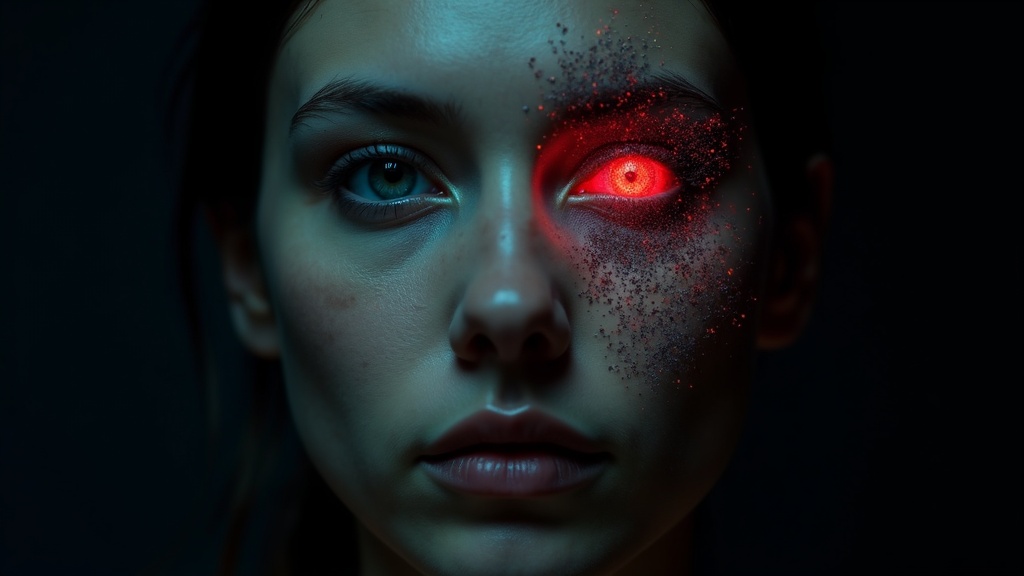
In February 2024, a finance worker at a multinational corporation joined a video call with his CFO and several colleagues. He transferred $25 million to accounts they requested.
None of the people on that call were real.
Every face. Every voice. The CFO. The colleagues. The entire meeting — generated by AI in real time. By the time anyone realized what happened, the money was gone.
This is not a warning about the future. This already happened. And the technology that made it possible has gotten significantly better since then.
We are living through the most disorienting shift in information history: for the first time, seeing something is no longer proof that it happened. Hearing someone’s voice is no longer proof they said it. A photo is no longer proof of anything.
Here’s what you actually need to know — and the five signals that can still tell you what’s real.
Why Deepfakes Are Different Now
The word “deepfake” existed before most people knew it was possible. Early deepfakes were obvious — rubbery faces, unnatural blinking, poor lip sync. You could spot them if you knew what to look for.
That era is over.
The current generation of synthetic media — produced by models like Sora, HeyGen, ElevenLabs, and dozens of specialized tools — can generate footage indistinguishable from reality to the human eye. Not “pretty good.” Indistinguishable.
What changed:
- Training data scaled from millions to billions of images and video frames, eliminating the visual artifacts that used to betray AI generation
- Real-time generation means deepfakes can now be produced live during video calls, not just pre-recorded
- Voice cloning requires 3 seconds of audio. Three seconds. A voicemail. A podcast clip. A social media video. That’s all an attacker needs to clone someone’s voice convincingly enough to pass a phone verification.
- Accessibility dropped from requiring specialized hardware and expertise to a browser tab and a $20/month subscription
The technical barrier is gone. The question is no longer “can this be faked?” The question is “how do I know if this is real?”
The Scale of the Problem in 2026
Before the detection guide, the scope matters:
- 500,000+ deepfake videos were circulating online as of 2023 — that number has grown by orders of magnitude since then
- Non-consensual intimate deepfakes represent the majority of deepfake content by volume, with devastating real-world consequences for victims
- Synthetic voice fraud cost businesses an estimated $40 billion globally in 2025
- Political deepfakes circulated in over 30 countries during elections in the past two years, often indistinguishable from authentic footage to voters
- Identity document deepfakes — AI-generated photos that pass KYC verification — are now a primary vector for financial fraud
This isn’t a niche problem. It touches every domain where trust in visual or audio evidence matters — which is every domain.
Sign #1: The Eyes Don’t Lie (But AI Struggles With Them)
The eyes remain the most reliable tell in deepfake video, for reasons rooted in how generative models work.
Human eyes have a set of micro-behaviors so complex that current models consistently fail to reproduce them accurately:
What to look for:
- Blink rate. Humans blink 15–20 times per minute in natural settings. Many AI-generated faces blink less frequently or at irregular intervals — watch for it over 30+ seconds of footage.
- Iris consistency. In real footage, the iris maintains its shape and detail through light changes. In deepfakes, the iris can momentarily lose detail or change shape slightly during fast movements or lighting shifts.
- Catchlights. The small reflections of light sources visible in real eyes should match the environment. In poorly generated deepfakes, these reflections are inconsistent with the light sources visible in the scene.
- Gaze direction. Real people’s eyes follow a coherent point in space. AI-generated faces sometimes show gaze that doesn’t quite track correctly with head movement.
None of these are foolproof individually. Combined, they paint a picture.
Sign #2: The Boundary Problem
AI-generated faces have a structural weakness: the edges where the face meets the background, hair, or other objects.
The reason is technical. Generative models learn to produce the central, well-defined parts of faces with high fidelity. The complex, semi-transparent boundary regions — where individual hair strands separate from the background, where ear edges meet hair, where a chin fades into a collar — are computationally harder to generate consistently.
What to look for:
- Hair edges — Individual strands of hair should be distinct. In deepfakes, the hairline often has a slightly blurred, painted, or “halo” effect. Still frames are better for this than real-time observation.
- Ear edges — The boundary between the ear and the background frequently shows compression artifacts or unusual smoothness in deepfakes.
- Facial boundary during motion — When the head turns, watch the edge of the face against the background. AI compositing often shows a thin ghost edge or slight color bleeding at the boundary during motion.
- Teeth and the inside of the mouth — When a subject smiles or speaks, AI models frequently struggle with realistic teeth generation. Look for teeth that are unusually uniform, blurred, or slightly wrong in shape.
Sign #3: Lighting That Doesn’t Add Up
Physics is unforgiving, and generative AI models don’t always respect it.
In real video, light sources create consistent patterns across the entire scene. Shadows fall in the direction opposite the light source. Skin reflects light with subsurface scattering that produces specific color distributions. Specular highlights on the forehead and nose match the ambient environment.
AI-generated faces are often optimized to look attractive and lit well — but the lighting on the face doesn’t always match the environment of the scene it’s been placed in.
What to look for:
- Shadow consistency — Does the shadow under the nose, chin, and neck correspond to the visible light source? If there’s a window on the right but shadows fall left, something is wrong.
- Skin highlight patterns — The bright reflections on the nose, cheekbones, and forehead should match the apparent light source. Mismatches suggest compositing.
- Color temperature mismatch — The face may have warmer or cooler tones than the background, suggesting it was generated in a different lighting context.
- Ambient occlusion failure — Areas where the face meets the neck, ears, or collar should be slightly darker due to reduced light exposure. Missing ambient occlusion makes faces look “floating.”
Sign #4: Audio-Visual Synchronization Artifacts
Voice cloning and video deepfakes are often generated independently and combined in post-production. The synchronization between audio and video frequently betrays this.
This is where real-time deepfakes are most vulnerable — generating perfectly synchronized audio-visual output in real time pushes current technology to its limits.
What to look for:
- Lip sync on consonants — Vowels are relatively easy to sync. Consonants — particularly bilabial sounds like P, B, M that require specific lip shapes — are harder. Watch for slight delays or incorrect mouth shapes on these sounds.
- Breath timing — Natural speech has breathing patterns that create micro-pauses. Cloned voice audio often has unnaturally smooth breath management.
- Jaw movement vs. audio complexity — Complex speech sounds require specific jaw and tongue positions. AI video often shows a jaw moving in a simplified pattern that doesn’t fully match the phonetic content.
- Audio environment mismatch — Does the reverb and ambient noise of the voice match the apparent environment? A voice with outdoor reverb in what appears to be an indoor setting suggests compositing.
- Throat and body movement — Real people show subtle movement through the shoulders, neck, and body when they speak. Deepfakes often show a floating head quality with insufficient correlated body movement.
Sign #5: Context Is Your Most Powerful Tool
The most sophisticated deepfakes defeat visual and audio detection. No technical tell is universal. The ultimate defense isn’t in the pixels — it’s in the context.
Ask these questions before you trust visual or audio evidence:
Does this request pattern make sense? Legitimate executive communications don’t bypass normal channels to request urgent wire transfers, credential resets, or sensitive data via video call. If the request is unusual regardless of who appears to be making it, that’s your primary signal.
Can you verify through a separate channel? Call back on a number you already have. Send an email to an address you know is legitimate. The key: use a different channel than the one the request came through. A deepfake call cannot intercept your callback.
Is the emotional register manipulative? Deepfake attacks are engineered to bypass judgment by creating urgency, authority, or fear. If you feel pressured to act immediately, without verification, slow down. That pressure is a feature of the attack, not a property of the situation.
Does the person know things only they would know? Establish a shared secret with important contacts — a code word or phrase agreed on in advance that must be included in any high-stakes request. AI cannot guess a word it doesn’t know.
Is the video or audio available in higher quality? Deepfakes often circulate in compressed, low-quality versions specifically because compression artifacts mask generation artifacts. If someone is sending you compressed video as evidence of something, request the original.
🛡️ The AuraLink Threat Intelligence Perspective
At AuraLink, we track synthetic media threats as part of our core threat intelligence work. Here’s what the threat landscape actually looks like in 2026, beyond the headlines.
The industrialization of deepfake attacks means that the technology is no longer limited to well-resourced threat actors. Deepfake-as-a-service platforms exist on both the open web and dark web, offering custom video generation of specific targets for a fee. Your executives are targets. Your clients are targets. You are a target.
The shift to audio-first attacks is significant and underreported. Voice cloning requires far less computational resources than video deepfakes and is much harder to detect in real-time conversation. The majority of synthetic media fraud cases we see in 2026 involve audio, not video — because it’s cheaper, faster, and the defenses are weaker.
Synthetic identity fraud is reaching critical scale in financial services. AI-generated identity documents, selfies, and video liveness checks are bypassing KYC processes at banks, exchanges, and financial institutions globally. If your business does any form of identity verification, assume your current process can be defeated.
Reputation attacks via synthetic media are an underutilized but growing threat vector. Fabricated video of an executive making damaging statements, released to clients or media, can cause real business damage before it’s proven false. The retraction never travels as far as the original attack.
What organizations need to implement now:
- Out-of-band verification protocols for any financial transaction, credential change, or sensitive data request received via video or audio — regardless of who appears to be making the request
- Pre-shared verification codes between leadership team members for high-stakes communication
- Deepfake awareness training that goes beyond “here’s what deepfakes are” to “here’s our specific verification workflow when you’re not sure”
- Synthetic media monitoring for brand and executive impersonation across social platforms — most organizations discover attacks reactively, after damage is done
- Liveness detection upgrades for any customer-facing identity verification process
The Deeper Problem
Here’s what makes this genuinely hard: these five signs work today. They will work less well in six months, and significantly less well in two years.
The tells that betray current deepfakes exist because current models have specific limitations. Those limitations are being addressed actively by the research community — not for malicious purposes, but because making more realistic synthetic media is a commercially valuable capability.
The detection methods that exist today are playing catch-up with generation capabilities, and generation is winning on speed.
This means the long-term solution to the deepfake problem is not better human detection. It’s institutional: verified channels, authentication protocols, cryptographic signing of authentic media, and organizational workflows that don’t rely on visual or audio verification for high-stakes decisions.
The goal isn’t to train yourself to spot every deepfake. The goal is to build systems where it doesn’t matter whether you can spot them.
Frequently Asked Questions
Can AI detect deepfakes? Yes, with varying accuracy. Detection models exist and perform well on known generation methods, but are often defeated by new generation techniques. No AI detector is reliable enough to use as a sole verification method.
Is it illegal to create a deepfake? Laws vary by jurisdiction. As of 2026, several countries and US states have criminalized non-consensual intimate deepfakes and deepfakes used for fraud. Laws have not kept pace with technology.
What should I do if I find a deepfake of myself? Document it (screenshots, URLs, metadata), report it to the platform, and contact a cybersecurity professional or attorney. Some platforms have expedited removal processes for synthetic media. AuraLink provides incident response for deepfake attacks.
How do I protect my voice from being cloned? Limit public audio of your voice where possible, particularly long uninterrupted samples. More importantly, assume your voice can be cloned and implement verification workflows that don’t rely on voice as a trust signal.
Your executives are being targeted. Your clients are being impersonated. The synthetic media threat is live.
AuraLink provides deepfake threat monitoring, synthetic media incident response, and organizational training for the reality of 2026.
If a deepfake attack is already in progress against your organization or brand:
Contact AuraLink Immediately →
AuraLink AI Security — because the most dangerous lies in 2026 look exactly like the truth.
More Articles

AuraLink AI Security
Is Your Business Protected?
Run a free AI-powered security scan — instant results, no credit card required.