Nobody talks about this enough.
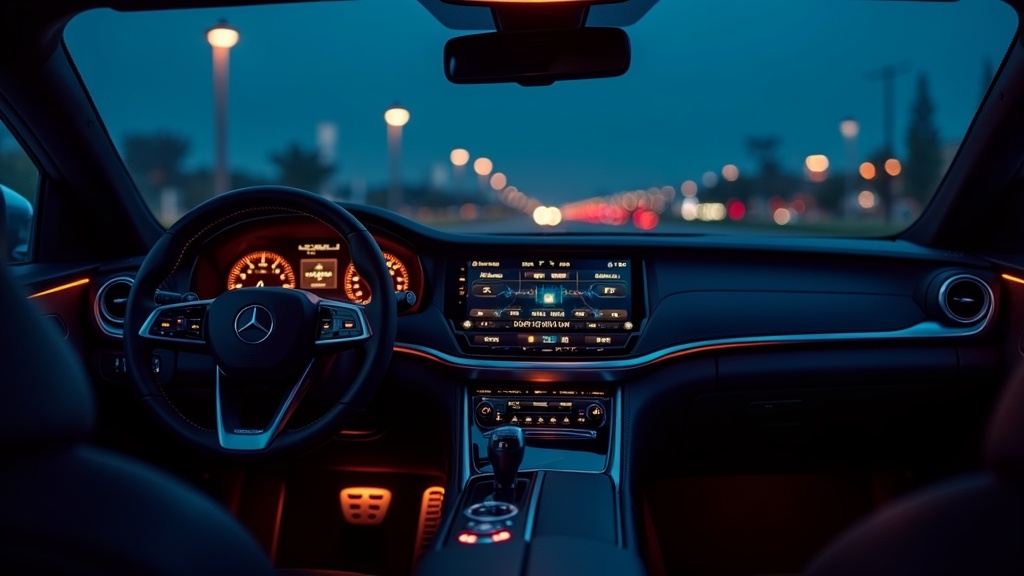
While the tech world obsesses over self-driving cars and autonomous vehicles, something quieter and arguably more interesting is happening inside the dashboard of modern cars — and it’s being powered by AI.
The car as a command center. The car as a concert hall. The car as the one place on earth where you’re completely in control of your environment.
AI is making that experience something nobody could have imagined ten years ago.
Your Car Is Learning How You Listen
Modern AI-powered audio systems don’t just play music. They adapt.
They learn that you blast hip-hop on your morning commute but switch to ambient when you’re stuck in traffic. They know you turn the bass up on the highway and prefer vocal clarity in the city. They detect the acoustics of your specific cabin — the shape, the materials, the number of passengers — and adjust the EQ in real-time.
This isn’t futurism. Brands like Meridian, Bang & Olufsen, and Burmester are already shipping systems with acoustic spatial processing that maps the sound field to your exact seating position. AI-driven digital signal processing adjusts hundreds of parameters per second.
The result: the same song sounds like it was recorded for your specific car, your specific seat, your specific moment.
The Tuning That Never Stops
Traditional car audio tuning is a one-time setup. You go to a shop, they tune the system, and it stays that way until something changes.
AI tuning is continuous.
It reads:
- Vehicle speed — compensating for road noise that increases with velocity
- Window position — open windows change the acoustic environment completely
- Ambient noise levels — construction, rain, highway versus city
- Passenger count — four people absorb sound differently than one
- Temperature — yes, speaker performance changes with temperature
Every variable, adjusted continuously, in real-time, invisibly.
You just hear the music. Perfect. Always.
The Center Console as Command Center
This is the part I find most compelling.
The center console of a high-end car in 2026 is genuinely a command center. A curved screen that spans the dashboard. Haptic feedback. Voice that understands context, not just commands.
You don’t say “play something.” You say “I need energy for the next hour” and the AI builds a playlist based on your history, your heart rate if you’re wearing a watch, the time of day, and your typical listening patterns at this speed on this type of road.
You say “call the office” and it knows which office. It knows your schedule. It knows you have a meeting in 40 minutes and suggests leaving now based on current traffic.
The car isn’t just transportation anymore. It’s the most personalized computing environment most people own — because it’s the one place they’re alone, focused, and in control.
Sound as an Experience, Not a Feature
Here’s the shift that AI enables that nothing else could:
Sound becomes spatial.
Dolby Atmos in cars. 3D audio that places instruments around you in three-dimensional space. A guitar that feels like it’s coming from your left. Vocals that sit exactly in front of you. Bass that you feel before you hear.
When AI manages the processing, it can do something a human tuner can’t — it can maintain that spatial experience as the car moves, as the acoustics shift, as the environment changes.
The best car audio experiences today feel less like listening to music and more like being inside it.
The Security Angle (Yes, Really)
Here’s something nobody thinks about:
Modern connected vehicle systems — the same AI that tunes your audio, manages your climate, connects your phone — are attack surfaces.
Your car knows where you live. It knows your routine. It stores your contacts, your calendar, sometimes your payment information. It connects to your phone constantly.
A compromised vehicle system isn’t just inconvenient. It’s a privacy breach on wheels.
The same principles that apply to business security apply to connected vehicles: connected means exposed, exposed means targeted, and targeted means you need to know who’s watching.
We think about this stuff so you don’t have to.
What’s Coming Next
The next wave isn’t hardware. It’s personalization at a level that doesn’t exist yet.
An AI that has learned your listening habits across three years, across seasons, across moods — that knows the exact song that pulls you out of a bad day, the album that makes a long drive feel short, the playlist that turns a commute into something you actually look forward to.
Your car knowing you better than a DJ who’s followed you for years.
That’s where this goes. And honestly? I can’t wait.
AuraLink AI Security — we think about the parts of the connected future most people overlook. Including the ones on four wheels.
More Articles



AuraLink AI Security
Is Your Business Protected?
Run a free AI-powered security scan — instant results, no credit card required.